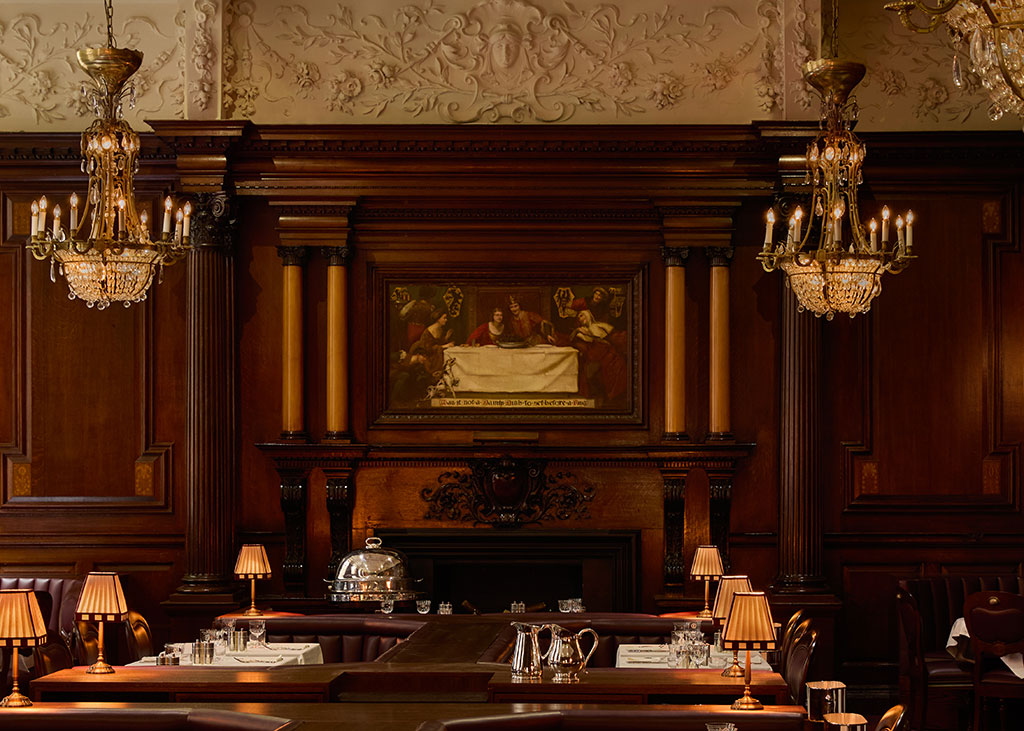
Given our long and illustrious history, some of the artwork at Simpson’s is a relic of a previous era. Arlid Rosenkrantz’s painting ‘Sing a Song of Sixpence’ is one of them.
Commissioned in 1904, it portrays a scene from the classic Mother Goose nursery rhyme about — among other things— a blackbird pie.
“Wasn’t that a dainty dish to set before the king?”
(In our painting, it has been changed to, “Was it not a dainty dish to set before a King?”)
Rosenkrantz was born in Denmark, but at aged 16, was sent to Rome to study with the fresco painter Modesto Faustini. After stints in Paris and New York, he moved to England, where he spent much of his career.
Rosenkrantz was fascinated by children’s imagery. Somewhat unusually for someone with such a preoccupation, he was associated with the late Symbolist and Theosophical movements. He and his artistic circle were fascinated by sacred geometry and mysticism. These interests and references added layers of meaning to his nursery-rhyme paintings, lending them a fantastical, almost spiritual feeling.
In addition to his portraits and decorative paintings, he was also accomplished in the realm of stained glass; one of his best-known works is the East window at St Andrew’s, Wickhambreaux in Kent.
Upon joining the Anthroposophic Society, he met Rudolf Steiner, who introduced him to Goethe’s theory of colour. It was a long and fruitful collaboration, resulting in many spiritually-themed paintings.
Some of them can now be enjoyed at Rosenholm, the castle in Denmark where he and his wife spent their final years.
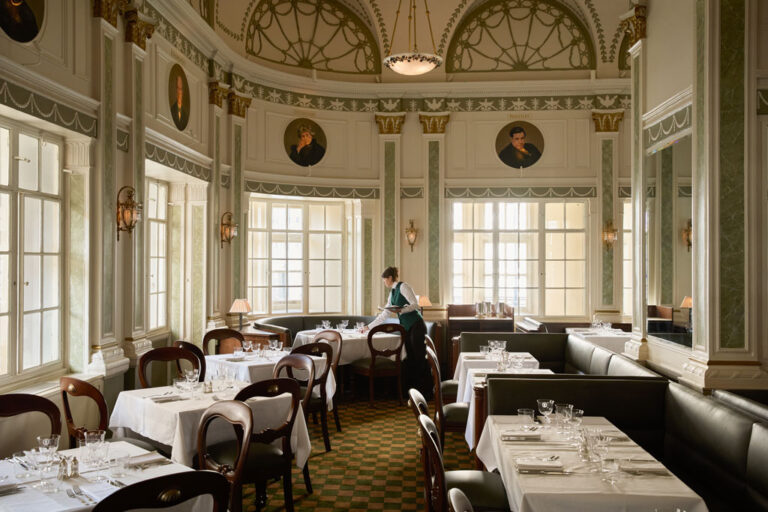
Dine beneath a piece of Simpson’s history
Experience the Grand Divan for yourself, surrounded by the character, artwork and traditions that have shaped Simpson’s in the Strand for generations.